
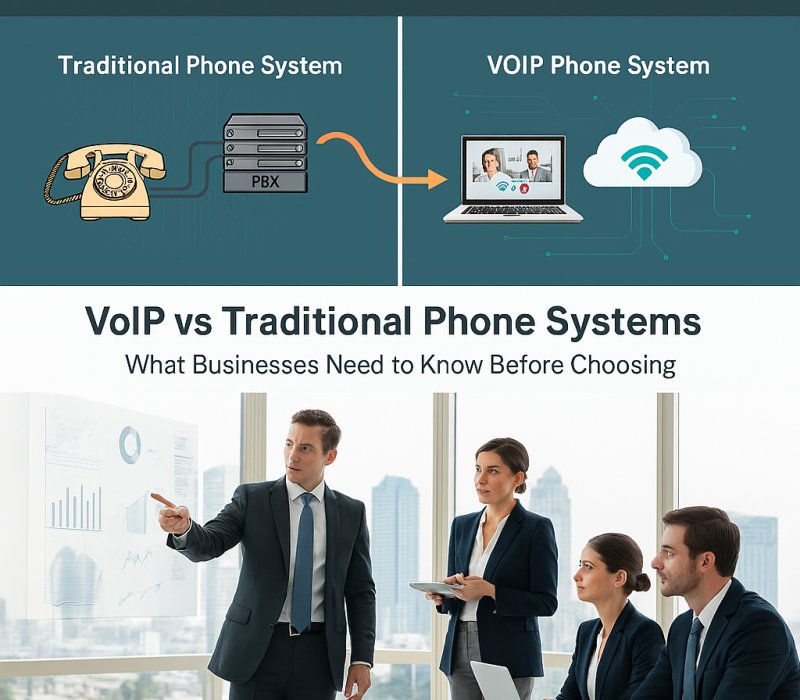
For many Jacksonville and Northeast Florida businesses, the phone system is still the backbone of daily communication. It connects employees, customers, vendors, and partners throughout the workday.
But here is a problem many companies do not realize.
The wrong phone system does not just slow down communication. It quietly costs your business efficiency, responsiveness, and opportunities.
That leads to a question many organizations are asking today.
Should you stick with a traditional phone system or move to VoIP?
At Total Business Systems, we help businesses modernize their IT and communication systems so they are more reliable, more secure, and easier to manage. Below is a clear breakdown of VoIP versus traditional phone systems and what makes the most sense for today’s business environment.
What Is a Traditional Phone System?
A traditional phone system, often called a landline or PBX system, uses physical telephone lines installed through a carrier. These systems have been around for decades and rely heavily on onsite hardware.
Key characteristics:
- Physical copper phone lines or on‑premises PBX hardware
- Desk phones connected through internal building wiring
- Separate infrastructure from your internet connection
- Maintenance often requires on‑site technician visits.
Strengths:
- Stable call quality in areas with strong telecom infrastructure
- Predictable performance when lines and hardware are well-maintained
- Familiar systems for long‑established organizations
Limitations:
- Expensive installation and ongoing maintenance
- Difficult to scale as your business grows
- Limited support for remote or hybrid work
- Hardware failures can cause extended downtime
- Upgrades are slow and costly
Real‑world example:
We regularly see businesses relying on aging PBX systems that were installed many years ago. When a key component fails, parts can be difficult or expensive to replace. The result is phone outages that interrupt staff, customers, and sales at the worst possible time.
For many growing businesses, traditional phone systems are becoming harder to justify due to cost and lack of flexibility.
What Is VoIP (Voice over Internet Protocol)?
VoIP phone systems run over your internet connection instead of physical phone lines. Calls are converted into digital data and transmitted securely over the network.
This is the same technology behind platforms like Microsoft Teams Calling, Zoom Phone, and other modern business communication tools.
The shift is not just technical. It changes how businesses operate day to day.
Key characteristics:
- Uses your internet connection instead of copper phone lines
- Works on desk phones, laptops, and mobile devices
- Cloud‑based management and configuration
- Seamless integration with email, CRM platforms, and productivity tools
Strengths:
- Lower monthly and long‑term costs
- Easy to scale up or down as your team changes
- Supports remote and hybrid work environments
- Advanced features such as voicemail‑to‑email, call routing, and analytics
- Faster deployment and easier updates
Limitations:
- Dependent on internet quality and stability
- Requires proper network configuration for consistent performance
- Security must be managed correctly.
This is where having a strong, managed IT foundation becomes critical, especially for businesses that rely heavily on voice communication.
VoIP vs. Traditional Phone Systems: The Real Comparison
Here is how these systems compare in real business terms.
1. Cost
Traditional phone systems often require the following:
- Hardware purchases
- Line installation fees
- Ongoing maintenance contracts
VoIP typically offers:
- Lower upfront costs
- Predictable monthly pricing
- Reduced maintenance overhead
Winner: VoIP
2. Flexibility and Remote Work
Traditional phone systems are tied to a physical office location. That can create challenges for remote employees or businesses with multiple locations.
VoIP allows employees to:
- Answer business calls from anywhere
- Use mobile apps as their business phone line
- Move seamlessly between devices
Winner: VoIP
3. Reliability
Traditional phone systems are known for consistent call quality, but they are still vulnerable to outages caused by damaged lines or failing hardware.
VoIP reliability depends on:
- Internet connection quality
- Network configuration
- Ongoing IT support and monitoring
With a properly managed network, VoIP can deliver reliability equal to or better than traditional voicemail and phone services.
Winner: Tie, depending on IT infrastructure quality
4. Features and Integrations
Traditional systems usually offer basic calling features.
VoIP systems provide:
- Call forwarding and intelligent routing
- Auto attendants and call queues
- Call recording and reporting
- Integration with Microsoft 365 and CRM systems
Winner: VoIP
5. Scalability
Traditional systems require physical hardware changes to add users.
VoIP allows businesses to:
- Add or remove users quickly
- Scale across multiple locations
- Support seasonal or growing teams
Winner: VoIP
Why Businesses Are Moving to VoIP
In today’s fast‑moving business environment, companies cannot afford rigid communication systems. VoIP has become the standard because it supports:
- Remote and hybrid work
- Growth without expensive hardware upgrades
- Lower operating costs
- A more responsive customer experience
However, one important detail is often missed.
VoIP is only as reliable and secure as the network it runs on.
Without proper IT management, issues such as call drops, poor audio quality, latency, and security risks can appear quickly.
The IT and Security Factor Most Businesses Miss
Switching to VoIP is not just a phone upgrade. It is a network and cybersecurity decision.
To run VoIP effectively, businesses need the following:
- Proper bandwidth allocation
- Network security controls
- Firewall configuration
- Quality of Service settings
- Ongoing monitoring and support
Real‑life scenario:
We have worked with businesses that moved to VoIP without security monitoring in place. In one case, unauthorized access resulted in fraudulent international calls that went unnoticed until billing statements arrived. With proper monitoring and controls, these issues are completely preventable.
At Total Business Systems, VoIP implementations are designed as part of a complete managed IT strategy that prioritizes performance and security.
When Traditional Phone Systems Still Make Sense
While VoIP is the modern standard, traditional systems may still be appropriate in limited scenarios:
- Extremely stable legacy environments
- Offices with unreliable internet connectivity
- Highly regulated systems that require isolated infrastructure
Even in these cases, hybrid solutions are often a smarter long‑term approach.
Final Verdict: VoIP Is the Future, but Setup Matters
For most businesses, VoIP delivers more flexibility, improved features, and lower long‑term costs.
But its success depends on one thing.
Proper IT planning and ongoing support.
Without that foundation, even a well‑known VoIP platform can underperform.
How Total Business Systems Helps Businesses Succeed
Total Business Systems provides managed IT services, cybersecurity, and business communication solutions for organizations throughout Jacksonville and Northeast Florida.
We help businesses:
- Plan and deploy VoIP systems correctly
- Secure networks for voice traffic
- Integrate phone systems with Microsoft 365
- Monitor performance and prevent downtime
- Support teams with responsive, knowledgeable IT professionals
👉 Thinking about upgrading your phone system?
Visit https://www.tbs 1.com/contact to speak with our team.
Ready to Modernize Your Business Phones?
Your phone system should make communication easier, not harder.
If you are evaluating VoIP or struggling with an outdated phone system, Total Business Systems can help you design a solution that supports your team, your workflow, and your growth.
- Request a consultation
- Ask about VoIP and managed IT services
- Get expert guidance tailored to your business
Schedule a consultation with Total Business Systems today and see what a properly managed VoIP solution can do for your organization.